
Wire Rope Safe Working Load (SWL) Chart
SWL = Minimum Breaking Force ÷ 5
The SWL-to-MBF ratio shall be verified by the manufacturer of the rigging elements; their published rating governs.
Independent Wire Rope Core; higher strength, crush resistance, and stiffness
| Diameter(in) | Weight(lb/ft) | IPS SWL(lbf) | IPS SWL(t) | EIPS SWL(lbf) | EIPS SWL(t) | EEIPS SWL(lbf) | EEIPS SWL(t) |
|---|---|---|---|---|---|---|---|
| 1/4" | 0.12 | 1,176 | 0.53 | 1,360 | 0.62 | — | — |
| 5/16" | 0.18 | 1,832 | 0.83 | 2,108 | 0.96 | — | — |
| 3/8" | 0.26 | 2,624 | 1.19 | 3,020 | 1.37 | 3,320 | 1.51 |
| 7/16" | 0.35 | 3,556 | 1.61 | 4,080 | 1.85 | 4,480 | 2.03 |
| 1/2" | 0.46 | 4,600 | 2.09 | 5,320 | 2.41 | 5,840 | 2.65 |
| 9/16" | 0.58 | 5,800 | 2.63 | 6,720 | 3.05 | 7,400 | 3.36 |
| 5/8" | 0.72 | 7,080 | 3.21 | 8,240 | 3.74 | 9,080 | 4.12 |
| 3/4" | 1.04 | 10,240 | 4.64 | 11,760 | 5.33 | 12,960 | 5.88 |
| 7/8" | 1.41 | 13,840 | 6.28 | 15,920 | 7.22 | 17,520 | 7.95 |
| 1" | 1.85 | 17,960 | 8.15 | 20,680 | 9.38 | 22,760 | 10.3 |
| 1-1/8" | 2.34 | 22,600 | 10.3 | 26,000 | 11.8 | 28,600 | 13.0 |
| 1-1/4" | 2.89 | 27,760 | 12.6 | 31,960 | 14.5 | 35,160 | 15.9 |
| 1-3/8" | 3.49 | 33,400 | 15.2 | 38,400 | 17.4 | 42,400 | 19.2 |
| 1-1/2" | 4.16 | 39,560 | 17.9 | 45,600 | 20.7 | 50,000 | 22.7 |
| 1-5/8" | 4.88 | 46,000 | 20.9 | 52,800 | 23.9 | 58,400 | 26.5 |
| 1-3/4" | 5.66 | 53,200 | 24.1 | 61,200 | 27.8 | 67,600 | 30.7 |
| 1-7/8" | 6.49 | 60,800 | 27.6 | 69,600 | 31.6 | 76,800 | 34.8 |
| 2" | 7.39 | 68,800 | 31.2 | 79,200 | 35.9 | 86,800 | 39.4 |
| 2-1/8" | 8.34 | 76,800 | 34.8 | 88,400 | 40.1 | 97,200 | 44.1 |
| 2-1/4" | 9.35 | 86,000 | 39.0 | 98,800 | 44.8 | 108,800 | 49.4 |
| 2-3/8" | 10.4 | 95,600 | 43.4 | 109,600 | 49.7 | 120,400 | 54.6 |
| 2-1/2" | 11.6 | 104,800 | 47.5 | 120,800 | 54.8 | 132,800 | 60.2 |
| 2-5/8" | 12.8 | 115,200 | 52.3 | 132,400 | 60.1 | 145,600 | 66.0 |
| 2-3/4" | 14 | 125,600 | 57.0 | 144,400 | 65.5 | 158,800 | 72.0 |
| 2-7/8" | 15.3 | 136,400 | 61.9 | 156,800 | 71.1 | 172,400 | 78.2 |
| 3" | 16.6 | 148,000 | 67.1 | 170,000 | 77.1 | 187,200 | 84.9 |
| 3-1/8" | 18 | 159,600 | 72.4 | 183,200 | 83.1 | 201,600 | 91.4 |
| 3-1/4" | 19.5 | 171,600 | 77.8 | 196,800 | 89.3 | 216,400 | 98.2 |
| 3-3/8" | 21 | 183,600 | 83.3 | 211,600 | 96.0 | 232,800 | 105.6 |
| 3-1/2" | 22.7 | 196,400 | 89.1 | 225,600 | 102.3 | 248,000 | 112.5 |
Pick core and grade from the rope tag or cert first, then read across to the diameter: 3/4 in runs from 47,600 lbf MBF (FC IPS) to 64,800 lbf MBF (IWRC EEIPS), a 36% spread, so never size by diameter alone. A dash means not produced in that grade.
Metric ton (t) columns are derived at 2,204.62 lb/t, to two decimals below 10 t and one above. Display only; the data carries lbf.
Suppliers opens NETWORK filtered to suppliers with known stock at that diameter. Stock ranges are a procurement aid, not confirmed inventory. Verify construction, grade and availability with the supplier.
Tool NotesWhat it does, the formula, and what it assumes
What this tool does
A lookup table of 6×19 wire rope: minimum breaking force and safe working load by diameter, for fiber core and IWRC, in Improved Plow Steel (IPS), Extra Improved Plow Steel (EIPS) and Extra Extra Improved Plow Steel (EEIPS) grades.
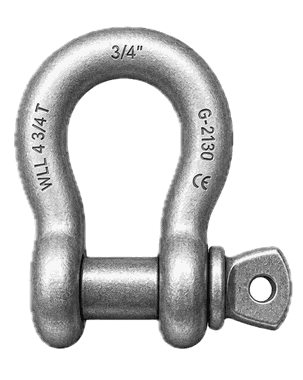
Shackle capacities sit alongside it, so the rope and the hardware that terminates it can be picked off the same page.
Formula
Safe working load is minimum breaking force divided by the design factor. The tables here use 5:1, the design factor for wire rope slings.
SWL = Minimum Breaking Force / 5design factor 5:1Select rope: SWL ≥ required tensionSelect shackle: SWL ≥ required tensionVertical capacity per leg = SWL × sin αα measured from horizontal; an angled leg lifts less than its straight-pull SWL, and the shallower the angle, the less it liftsAssumptions
The tables list Safe Working Loads (SWL) for wire rope using a 5:1 design factor. Shackles list the manufacturer's stamped Working Load Limit. Values assume a straight vertical pull; no sling-angle reduction, dynamic amplification, or D/d bending loss is built in.
- Design factor 5:1, SWL = minimum breaking force ÷ 5. The SWL-to-MBF ratio shall be verified by the manufacturer of the rigging elements; their published rating governs.
- Vertical pull, a single leg loaded straight down; angled or multi-leg lifts raise tension and must be derated.
- Static, no shock, swing, or impact factor is included.
- Condition, a published SWL applies to rope in as-new condition.
- Rope SWL, not sling WLL, termination efficiency is not applied. The fabricator's tagged WLL governs for a finished sling.
Technical NotesDerivation, worked example, applications and checks
How values are derived
Rope SWL is the catalog breaking force divided by the design factor; selection returns the smallest size whose SWL meets the required tension. Shackles are chosen by their rated SWL. Minimum breaking force is a published property of the rope; it is never calculated. The equations are in the Formula block above.

- Grades & core, breaking strength IPS < EIPS < EEIPS; an IWRC core is stronger than fiber core (FC).
- Shackles are not derived, a shackle carries the manufacturer's stamped Working Load Limit, and the ultimate column is their published minimum, carried as published. The 5:1 design factor is not applied to it in either direction.
Worked example
3/4 in 6x19 IWRC, EIPS grade
Given
- Diameter: 3/4 in
- Construction: 6×19 IWRC
- Grade: EIPS (Extra Improved Plow Steel)
Solve
Minimum breaking force = 58,800 lbffrom the tableSWL = 58,800 / 5 = 11,760 lbfdesign factor 5:12-leg pick at 60°: 11,760 × sin 60° × 2 = 20,369 lbusable verticalShackle: 3/4 in WLL 10,472 lb < 11,760 lb → use 7/8 in, WLL 14,330 lbfrom the shackle table11,760 lb per leg vertical. Two legs at 60° will lift roughly 20,370 lb. Same pair at 30°: 11,760 × sin 30° × 2 = 11,760 lb. Sling angle halves the usable lift.
D/d ratio
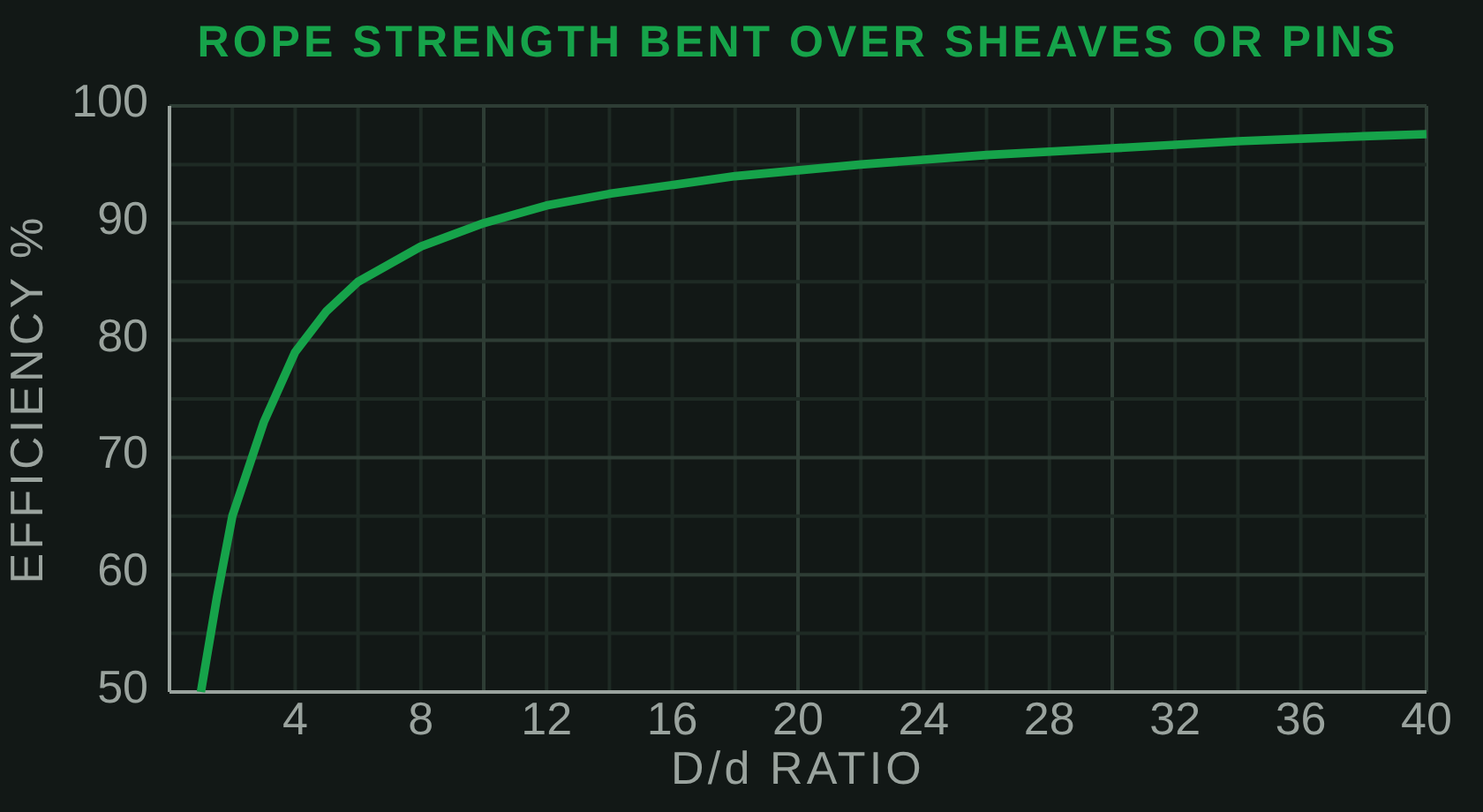
D/d = D / d. D = diameter of the surface the rope bends around (pin, hook, sheave). d = nominal rope diameter. Larger D/d, gentler bend. Smaller D/d, more bending stress on the wires and less rope efficiency.
3/4 in 6×19 eye-and-eye sling, no thimble
Given
- Sling: 3/4 in 6×19 eye-and-eye, no thimble
- Connection: the eye goes over a 3/4 in shackle pin, ≈ 0.88 in
Solve
D/d = 0.88 / 0.75 = 1.17Published sling ratings are commonly based on 25:1The shackle WLL checks out. The sling does not keep its published capacity at D/d = 1.17. Separate ratings; the connection geometry controls.
- No generic reduction factor, efficiency at small D/d depends on construction, grade, termination, and contact geometry. Use manufacturer data or a qualified person, not MBF × a guessed factor. The curve above is illustrative only, not design data.
- Thimbles change the connection, a properly sized thimble gives the eye a larger, controlled bearing surface. Consider a thimble where the eye connects directly to shackles, hooks, or master links, especially on repeat use.
- Unthimbled eye-and-eye slings, are made for basket and choker hitches, where the sling body wraps the load. In a vertical hitch, keep the bare eye off small pins.
- Fixes, larger-radius pin, hook or sheave; a thimble; a manufacturer-rated sling/shackle pairing; or a rated synthetic sling where the geometry forces a small radius.
Sling hitches and sling types
Sling hitch types & capacity
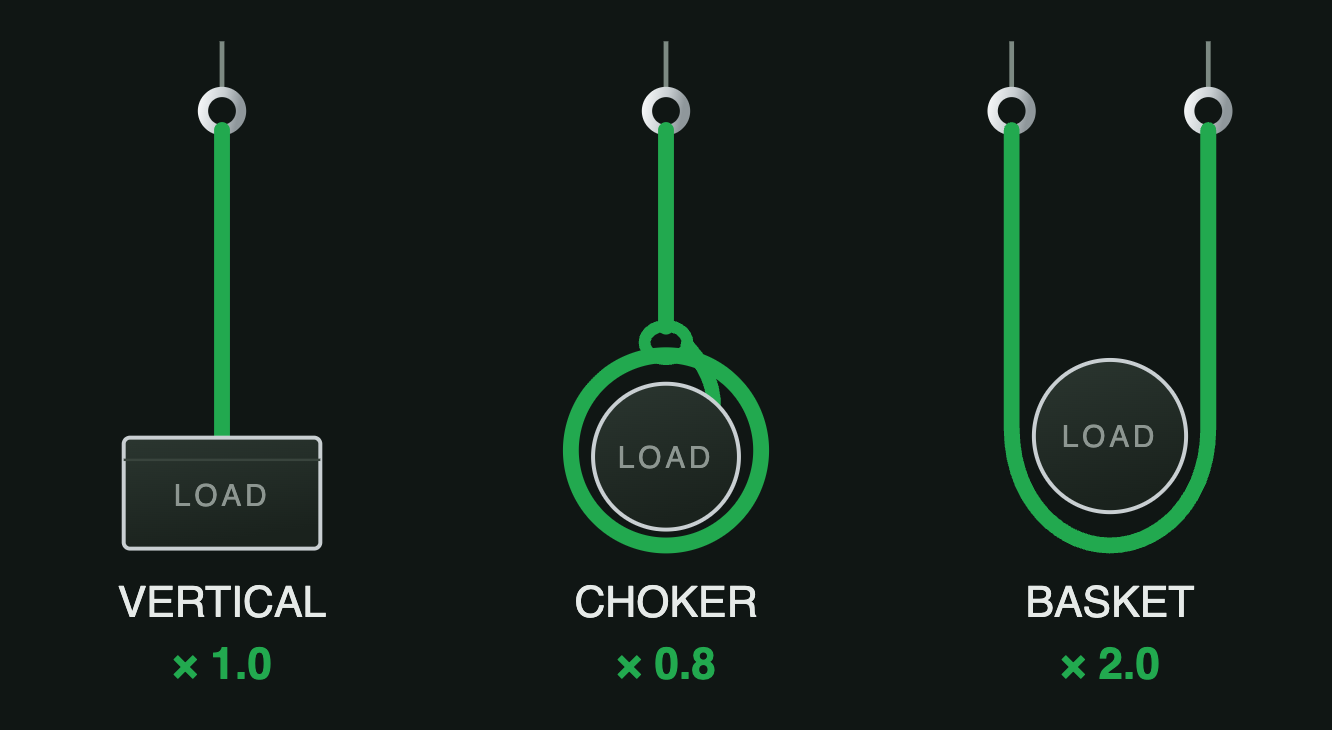
Factors are relative to the sling's rated vertical capacity.
| Hitch | Typical factor | Description |
|---|---|---|
| Vertical | 1.00× | One vertical leg supports the load. |
| Basket | 2.00× | Two portions of the sling carry the load. |
| Choker | 0.75–0.80× | Sling passed around the load and choked. |
Basket and choker factors are typical values, not universal ratings. Factors assume vertical legs; angled rigging reduces capacity further. Manufacturer's published rating for the specific configuration governs.
Synthetic vs wire rope slings
Synthetic (round and flat/web) slings are light, flexible, easy to handle, and kind to finished surfaces; round slings conform best, web slings position easily. Wire rope is heavier and stiffer but stands up to abrasion, rough handling, and heat, so it carries most heavy construction picks.
| Synthetic | Wire rope | |
|---|---|---|
| Weight | Light | Heavy |
| Flexibility | Excellent | Moderate |
| Surface protection | Excellent | Lower |
| Abrasion / cut resistance | Lower | Higher |
| Heat resistance | Lower | Higher |
| Best suited for | Finished, irregular, lighter loads | Heavy, rough, abrasive work |
Synthetics cut, abrade, and heat-damage easily: protect every edge. Wire rope can mark load surfaces and needs inspection for broken wires, kinks, bird-caging, and corrosion.
Applications & rules of thumb
- Mind the D/d ratio, bending rope over a small pin or sharp edge cuts its strength; keep the bend diameter large. The D/d ratio group above is where the numbers and the fixes are.
- Derate for dynamics, fast picks, swinging, or unequal legs push real tension above the static value; add margin.
- Pair with Pick Points, use the Pick Points tool to get the actual leg tension and angle, then size rope and shackle here.
Field notes
- 5:1 is the typical factor for wire rope slings. It is not universal, as some owners and jurisdictions specify higher. Confirm before you use these numbers.
- All rigging shall be inspected periodically, before and after use. Any rigging with broken wires, kinks, bird-caging, crushing or corrosion shall be removed from service immediately.
- Terminations govern. A wire rope clip assembly develops roughly 80% of the rope's strength; a properly poured or swaged socket develops close to 100%.
- Extra caution with synthetics, more open to cuts, abrasion, UV, heat, and chemicals than wire rope. Pad every edge; inspect before use.
Educational reference only. Verify every result independently and apply the safety factors and load combinations required by the governing code and a qualified engineer.
Quick reference
- QR01 - Sling Tension
PDF · 579 KB — Static Pick Analysis - Sling Tension and Angle 2 vs. 4-Sling Comparison, Equations, Worked Examples, Field Notes + More
- QR02 - Rigging
PDF · 1.0 MB — Wire Rope SWL - Selection, D/d Ratio, Sling Hitches, MBF Tables Equations, Worked Examples, Diagrams, Field Notes, Wire Rope and Shackle MBF Tables + More
- QR05 - Welds
PDF · 1.7 MB — Weld Strength Analysis - Equations, Worked Example, Strength Per Inch Table for E60-E120, Field Notes + More
Related tools
- Sling Tension & Sling Angle Calculator
find the leg tension this rope has to carry
- Steel Weight Calculator
establish the lift weight before you size the rope
- Engineering Unit Converter
tons, kips and kN: rope ratings and lift weights rarely arrive in the same unit