
Pipe Section Properties Calculator
Section properties for hollow circular sections (inches)
Enter valid dimensions, OD > ID ≥ 0
Tool NotesWhat it does, the formula, and what it assumes
What this tool does
Computes the section properties of round steel pipe from its outside diameter and wall thickness, or from OD and inside diameter if that is what you have on the drawing.
Returns area, moment of inertia, elastic and plastic section modulus, weight per foot at 490 lb/ft³, and the internal void volume. It handles wall thicknesses the standard schedule tables do not.
Formula
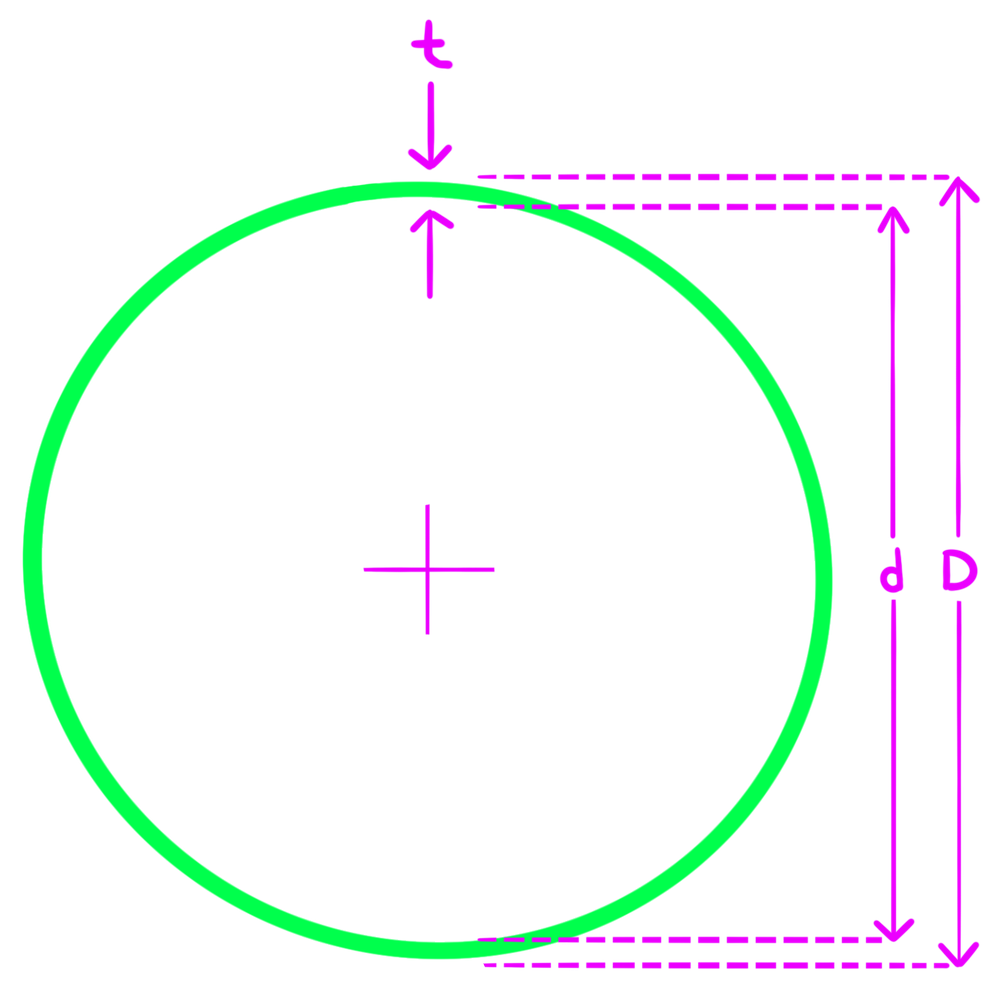
A pipe section is an annulus: the solid circle at OD minus the solid circle at ID, with d = D − 2t tying them together. D, d and t in inches.
A = (π/4)·(D² − d²)cross-sectional area, in²I = (π/64)·(D⁴ − d⁴)moment of inertia, in⁴S = I / (D/2)elastic section modulus, in³Z = (1/6)·(D³ − d³)plastic section modulus, in³w = A × 490 / 144weight per foot; A in in², w in lb/ftAssumptions
The pipe is modeled as a perfectly circular hollow section with a uniform wall. Properties are pure geometry; no pressure rating, corrosion, ovality, or mill tolerance is considered.
- Steel density, weight uses 490 lb/ft³ (structural steel); a different material scales the weight directly.
- Geometry in, properties out, supply outside diameter and wall (or inside diameter); the tool returns section properties, weight, and void volume.
- ASTM governs the dimensions, pipe size and dimensions are governed by the ASTM product specification, not by the nominal size. For example, ASTM A252 pipe piles: outside diameter may vary ±1% from specified, and wall thickness may be up to 12.5% under nominal. Enter the actual OD and the wall you're designing to.
- Not a code check, for pressure or structural design, apply ASME B31 / API / AISC provisions separately.
Technical NotesDerivation, worked example, applications and checks
How the properties are derived
The section is an annulus: a solid circle of outside diameter D with a concentric circle of inside diameter d removed. Every property in the Formula block above is the solid-circle value for D minus the solid-circle value for the void d, so a single wall thickness t ties the two together as d = D − 2t. The void itself is the one quantity that is not a difference:
V = (π/4)·d² / 144 · L internal (void) volume; d in in, L in ft, V in ft³Worked example
12 in OD pipe with a 1/2 in wall
Given
- D = 12 in
- t = 0.5 in, so d = 12 − 2(0.5) = 11 in
Solve
A = (π/4)(12² − 11²) = 18.1 in²I = (π/64)(12⁴ − 11⁴) = 299 in⁴S = 299 / 6 = 49.9 in³Z = (1/6)(12³ − 11³) = 66.2 in³w = 18.1 × 490 / 144 = 61.5 lb/ft18.1 in², 299 in⁴, 49.9 in³, 61.5 lb/ft for a 12 in OD × 1/2 in wall.
Applications
- Weight & volume, estimate shipping/lifting weight, or the fill volume inside the void.
- Compare, S and Z drive bending strength while I drives stiffness (deflection); use them to weigh one wall thickness against another.
Field notes
- Nominal pipe size is not outside diameter. 12 in nominal pipe has a 12.75 in OD; only from 14 in up does nominal equal OD. Enter the real OD.
- Round pipe has the same I about every axis, so there is no weak direction to orient. That is most of why it is used for bracing and posts.
Educational reference only. Verify every result independently and apply the safety factors and load combinations required by the governing code and a qualified engineer.
Quick reference
- QR01 - Sling Tension
PDF · 579 KB — Static Pick Analysis - Sling Tension and Angle 2 vs. 4-Sling Comparison, Equations, Worked Examples, Field Notes + More
- QR02 - Rigging
PDF · 1.0 MB — Wire Rope SWL - Selection, D/d Ratio, Sling Hitches, MBF Tables Equations, Worked Examples, Diagrams, Field Notes, Wire Rope and Shackle MBF Tables + More
- QR03 - Beam Analysis
PDF · 651 KB — Static Beam Analysis - Shear, Moment, Deflection, Equations, Worked Example, Field Notes, Reference Table, + More
- QR05 - Welds
PDF · 1.7 MB — Weld Strength Analysis - Equations, Worked Example, Strength Per Inch Table for E60-E120, Field Notes + More
- QR06 - Steel Shapes
PDF · 264 KB — Steel Shapes - Shape Designations, Equations, Worked Examples, Field Notes + More
Related tools
- Steel Weight Calculator
total the tonnage once you have the weight per foot
- ASTM Structural Steel Grades Reference
A53, A500 and A252: which pipe spec applies and what it is good for
- Structural Steel & Line Pipe Price Trends
LSAW and SSAW pricing per pound, month by month
Related reference
- Round HSS
every tabulated OD and wall thickness
- ASTM A53 Grade B
the common pipe spec
- ASTM A500 Grade C
round and shaped HSS
- AISC Shape Reference Index